
By Aysu Bicer
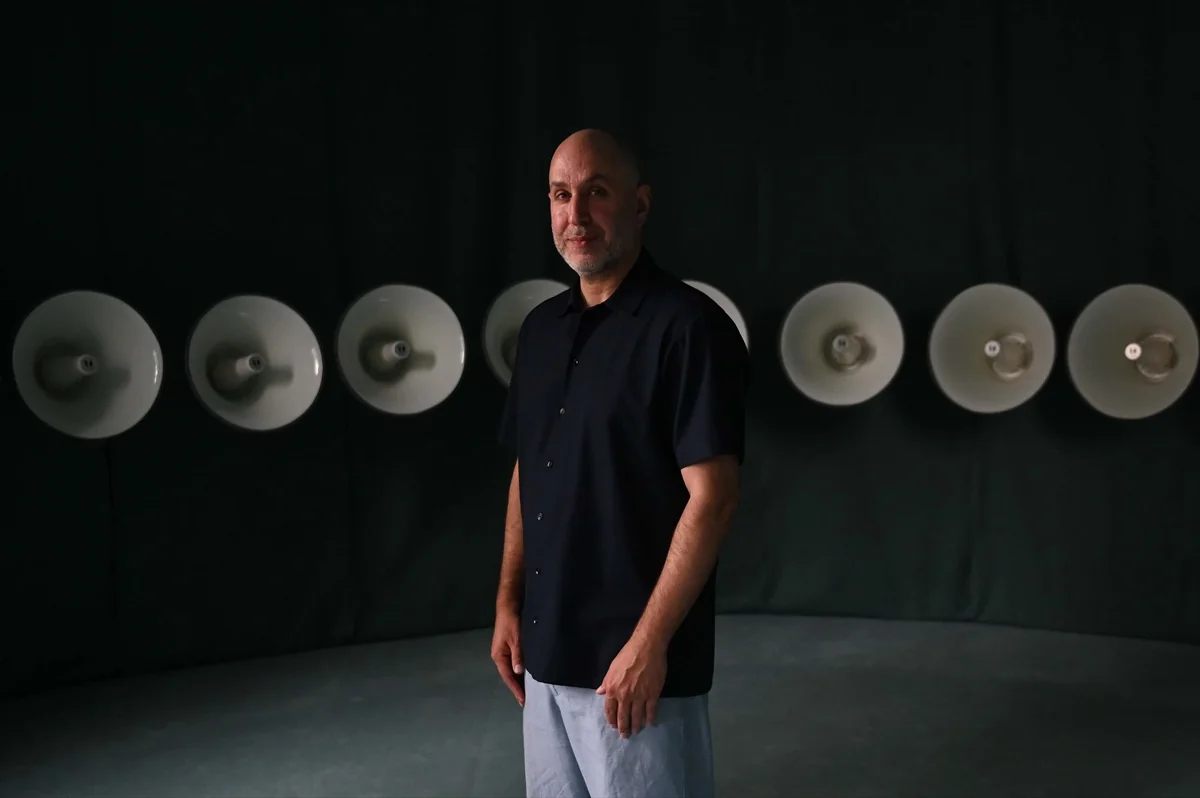
Tucked away just a stone's throw from the relentless hum of Oxford Street, a new sonic sanctuary has taken root in central London. Joe Namy, an American-born Lebanese artist and composer whose practice encompasses sound, its history, and its physical impact on the built environment, has brought his multi-channel sound installation, Cosmic Breath, to the UK capital.
The work is reimagined for Ibraaz's Musalla, a space dedicated to spiritual practice as both lived experience and creative expression.
Composed of recordings of the adhan—the Islamic call to prayer—the installation brings together historical and contemporary calls from different geographies, amplified through horn speakers like those mounted on mosque minarets.
Played simultaneously, each speaker softly emits a different adhan recording, inviting the audience to lean in and listen closely. At prayer times, the volume increases, making the calls clearly audible throughout the room, creating a congregation of calls to prayer.
'Interested in collective sound experiences'
The work forms part of Namy's wider exploration of sound systems, community, and spirituality.
First commissioned for the Islamic Arts Biennale in Jeddah in 2023 by its artistic director and architect, Sumayya Vally, the installation explores collective auditory experiences and public sound landmarks.
"A lot of my work deals with the politics of sound, and deals with the spirituality of sound as well, how it affects us in different ways," Namy explains. "So, I'm interested in sound system cultures (and) collective sound experiences as well, and how they impact our lives."
Developed in close collaboration with Vally, who designed the installation's spatial scenography, the artwork grew out of a poetic reflection on time and geography.
Namy was moved by the idea that "at any moment in time on Earth, there is an adhan happening somewhere on this planet, which I think is such a really powerful and beautiful gesture."
Approaching the adhan through a sociological lens, Namy examines how an ancient oral tradition has transformed alongside modern technology, amplification, and recordings.
Bringing the piece from Saudi Arabia to London reshapes its meaning dramatically, particularly given the current social atmosphere in the UK.
?From Jeddah to London: A different political soundscape
"Showing it for the first time in Jeddah was a very different experience than showing it here in London, which ... situates the work very differently than how it was situated there," Namy underlined.
He pointed directly to the heightened hostility surrounding the current political landscape: "Especially now today in the current kind of political climate here in London... there's just a more heightened kind of Islamophobia, xenophobia, prejudice... all these things that we've been experiencing and has been increasing."
For Namy, installing the piece in the heart of London serves as a sanctuary and an antidote to that hostility.
"I feel like it's a more powerful gesture to be able to show it here in the center of London, you know, just off of Oxford Street, and to be able to have this space for people to be able to come, relax," he said.
He notes how rare it is in contemporary art spaces to engage with faith so openly: "I think, what I really enjoy is the fact that it's thinking about the spirituality in relation to art, which you don't always get a chance to explore, but also providing a kind of third space for people to explore more."
A London memory born during lockdown
To ground the exhibition in its current environment, this iteration at Ibraaz features a local recording. "So, this recording is from London," Namy notes.
"Actually, it was important to bring in something that was local as well, and so this was actually one of the first recordings of a public adhan in London that happened in Walthamstow during COVID. It was again a time (when) everyone was social distancing, and so it was a way for the community to be able to kind of -- although they were distant -- to feel closer together, so it was important to bring in a local element into the setting as well, so that we have some a more closer connection to where we are here in London."
The recording captures the historic call performed by the Waltham Forest Islamic Association in 2020, offering a sonic expression of shared experience when physical gathering was impossible.
Adhans from Mecca to Singapore, Tbilisi to Khartoum
The audio selections in Cosmic Breath span more than a century and cross vast physical and acoustic terrains, revealing how each call carries a unique character shaped by local traditions, acoustic environments, and regional histories.
"The selections that we included within this installation each represent a certain aspect, or have a unique aspect for the adhan," Namy says. "Part of it is thinking about spaces (where) you normally wouldn't encounter the adhan, spaces in which recordings of the adhan are kind of historically significant as well."
Among the archival highlights is what is considered the first recording of the adhan at the Haram Mosque in Mecca, dating back to the late 19th century. "I think this one is the first recording that was ever done of the adhan from the late 1800s in Mecca. You can kind of hear the grain of the recording. It's not a really great recording, but it's interesting to hear it in context of all the other ones," Namy reflects.
From Asia, the piece gathers landmark history and geography.
"From the Philippines, (there is) an archival recording from the 1950s. It was one of the first recordings of the adhan in the Philippines," Namy points out.
Contemporary and historical selections also feature the Al-Aqsa Mosque in Jerusalem and Singapore's Sultan Mosque, thought to be the first mosque to adopt loudspeakers in the 1930s.
"This one is from Singapore, and this was recorded at the first mosque that actually used speakers to amplify the call to prayer. The mosque is still there, and that was important," he adds.
Other field recordings offer stark contrasts in style and setting—from the ornate to the stripped-back.
"This one is Georgia Tbilisi, and this one is probably the most flowery, I think. You really hear the improvisation and the embellishments and how the voice gets extended in the recitation," Namy says.
In contrast, "one is from the Sahrawi refugee camp in Algeria, and it's one of the only ones that's not recorded, that's not amplified," Namy explains saying, "It's somebody who is old school-style, kind of just reciting it without any speakers or anything like that, just their voice."
The installation captures deeply intimate acts of faith as well as distinct colloquial traditions.
"I think this one is from Japan," Namy shares, explaining that similar to the recording mentioned before, it was "somebody just kind of reciting it into the forest for themselves, basically, which I thought was a really beautiful gesture. So, it's a very personal personal recording reflection."
A call to prayer from Khartoum highlights regional identity: "This one is Khartoum. It's recorded in Sudan, and again, you hear the colloquial differences and how the adhan is recited. It's very different in the recitation. It's very Sudani in its style, which I really love."
Not every place could be captured on audio.
Namy recalls attempting to record the first mosque built in South America, located in Brazil. Because the building is reserved for special occasions, "you don't hear the adhan there, so we recorded just kind of like the empty space from that room, just to have that kind of gesture," though it ultimately remained unreleased alongside seaside field recordings from Egypt.
From South Africa, a protest becomes the seed of Cosmic Breath
The initial impulse for Cosmic Breath traces back to a pivotal moment of civic resistance in South Africa. During the COVID-19 lockdowns in 2020, rising social tension, Islamophobia, and xenophobia in Durban led to a local ban on publicly broadcasting the adhan.
In response, an act of interfaith solidarity emerged. "This protest was actually organized by a Hindu community member. He wasn't Muslim, but he organized this protest in solidarity with the Muslim community there," Namy recalls.
Sumayya Vally shared the link to the event with him, sparking the broader concept.
Restricted by social distancing rules, residents adapted: "How do you protest at a time when you can't congregate and gather together? And so they asked everybody to bring their cars and made this huge parade. Everybody tuned their car stereo systems to one of the channels that was broadcasting the adhan."
The resulting soundscape of hundreds of car speakers reverberating through the streets of Durban provided the foundation for the entire project. "This is the recording from that experience as well," Namy reflects.
"And that was kind of the first recordings that really made me think about the piece... and bring everything together."
Yorumlar
Yorumlar yükleniyor…